5 factors when choosing a LED screen for the control center
5 factors when choosing a LED screen for the control center, which we will talk about in detail.
1-How do you know which one you need?
Every company wants to envision, across its scale, a high ROI on investment so we’ve highlighted some of the key differences between different technologies. There are several other factors that will also influence this decision.
2-Dimensions of the room and walls.
The first simple criterion is the size of the control room. For small rooms, LED screen is usually the technology that has more application options and the thickness of the panel is very thin so the space occupied by LED screen is very small.
LED screens are also great for short viewing distances (providing a great viewing experience even at close range). Good viewing angles ensure that every operator can see the content on the LED screens comfortably even when the screen is at the edge of the room. If interaction is required, the LED screen It’s also a better option.
But usually in smaller rooms with a limited number of operators, LED screens are more comfortable in large and small rooms because they require more depth. The operator will have a great visual experience when looking directly at the screen, so for a medium to large control room where the operator is located slightly away from the wall, it is LED screens are an ideal choice.
It is very thin so it takes up very little space.
But depending on the pixel pitch, additional viewing distances will get the best results. For example, it is better to see a wall with a pixel pitch of 1.2 mm from a distance of 3 metres.
By the way, the optical properties of LED screens are not limited to small and medium-sized walls, but are also suitable for large rooms!
(5 factors when choosing a LED screen for the control center)
3-Lighting conditions.
It is an important factor among the 5 factors when choosing a LED screen for the control center.
In the past control rooms were often very dark environments so there was no ambient light source to interfere with the content of the LED screens.
However, the increasing brightness of the LED screen has changed this way of thinking. The brightness produced by the LED screen is also effective in brighter lighting conditions and this technology is rarely affected by what is called “specular reflection”.
Traditionally, LED screen backlit display cubes have a lower light output. LED source displays have a brightness of around 400 nits while an LCD video wall has a brightness of 500 nits.
These products are suitable for a variety of difficult lighting environments When designing a room’s lighting layout keep in mind the reflective nature of the display.
(5 factors when choosing a LED screen for the control center)
4- Light reflection.
It is one of the 5 factors when choosing a LED screen for the control center. In addition to the ambient light, the position of the light source is also very important. LCD, RPC and LED LED screens differ in light reflection.
First, there are two main types of reflections: specular and diffuse.
Specular reflection: Light falls on a mirror and is reflected in one direction.
Diffuse reflection is exactly the opposite: light is reflected equally in all directions.
Reflections can be an important parameter that can hamper the viewing experience of the operator and it needs proper attention.
The reflection of the LED screen is close to specular reflection, which requires a clever way to determine the position of the light fixture.
In most cases this isn’t a big problem: just make sure the lights aren’t facing the LED screen.
The LED screen works as a diffuser and for this type of LED screen the rule is that the darker the room, the better the contrast ratio.
The amount of light reflected from the RPC rear projection is limited making it a good solution for rooms with fixed lighting locations and windows in this room. The lighting conditions can be adjusted on the LED screen.
(5 factors when choosing a LED screen for the control center)
5-What is displayed on the LED screens?
The physical characteristics of the control room have been discussed above but the content on the LED screens is also very important.
In this area the gap between the screens or the width of the frame is an important parameter and it forms black lines around each screen which makes LCD screens look like a grid.
In facilities and process control a single application (SCADA) is often deployed across the entire LCD.
This means that the black lines will cross the content, preventing a smooth viewing experience. If the background is black, the lines will not be visible, but the content will remain choppy.
Among the three different technologies, LED technology is the only one that is completely smooth, ensuring a complete viewing experience.
LED screen has the sharpest interruption among displays and is commonly used in monitoring centers. However, LED screens with relatively small pixels on the market are almost seamless.
Now that you know the 5 factors when choosing a LED screen for the control center, there is something called “the best technology for LED screens.”
It all depends on the use case and what’s on the wall and infrastructure to determine what’s right for your needs.
(5 factors when choosing a LED screen for the control center)
LCD screen
Suitable for small and medium sized walls.
Doesn’t take up much space.
Excellent image quality for close-up viewing.
(5 factors when choosing a LED screen for the control center)
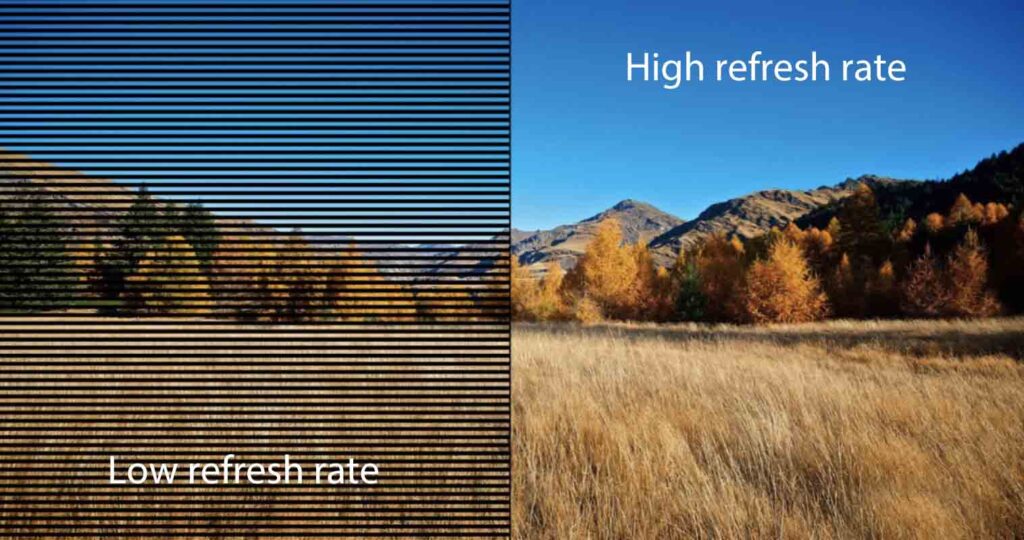
5 factors when choosing a LED screen for the control center
LED screen
Suitable for medium and large sized walls.
Very thin and takes up little space.
Very bright and can be used in brighter ambient light conditions.
Perfect, smooth and unlimited aspect ratio.
Good viewing angle.
Great for video-focused content.
For more information’s about our products, Click here
For our Facebook community, Click here